


animation-appreciation-education:
Gay Purr-ee
95 in x of animated feature film history
Release: Oct. 24th, 1962
Country: USA
Director: Abe Levitow“Gay Purr-ee features the voice of Judy Garland in her only animated-film role, as well as Robert Goulet in his first feature film.
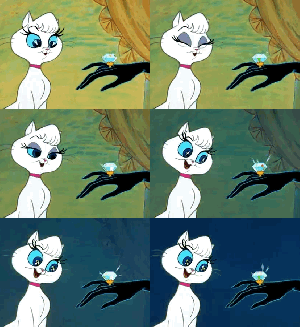
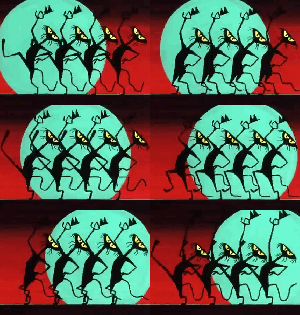
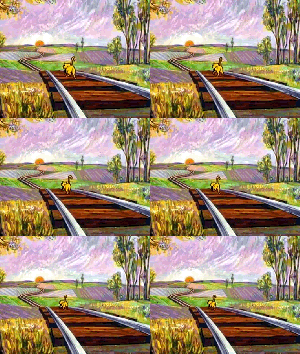
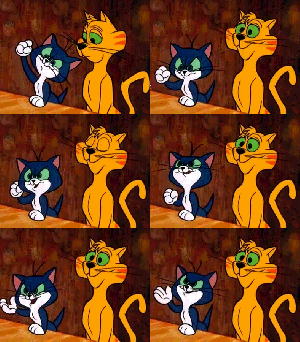
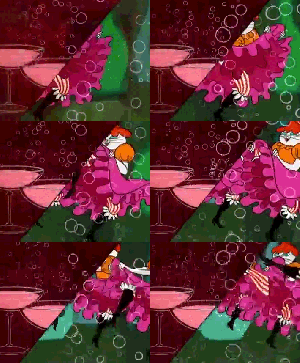
The story begins on a farm in rural Provence. The lovely housecat Mewsette and the accomplished but shy mouser Jaune Tom are in love. Inspired by the human Jeanette’s stories of glamour and sophistication in Paris, Mewsette runs away by taking a train to the big city, where she encounters the slick con-cat Meowrice. Taking advantage of the country kitty’s naivete, he puts her in the care of the sultry Madame Henretta Reubens-Chatte, who promises to turn Mewsette into a dainty debutante known as ‘The Belle of all Paris.’ Unbeknownst to Mewsette, Meowrice is grooming her to be the mail-order bride of a rich American cat in Pittsburgh. Meanwhile, Jaune Tom and his sidekick Robespierre arrive in Paris, searching for Mewsette.
Gay Purr-ee was the second and final feature film, following 1001 Arabian Nights with Mr. Magoo, produced by UPA (United Productions of America), a studio which had revolutionized animation during the 1950s by incorporating design and limited animation.
The script for Gay Purr-ee was written by Dorothy Webster Jones and her husband, Warner Bros. Cartoons veteran director Chuck Jones. The latter Jones also ultimately produced the project, moonlighting for UPA in violation of his exclusive contract with Warner Bros. One of the former animators from his Warner Bros. unit, Abe Levitow, directed the film. According to the production notes on the DVD edition, it was Garland who suggested that her Wizard of Oz songwriters, Harold Arlen and E.Y. Harburg, should write and compose Gay Purr-ee’s eight songs. Garland has stated that the song ‘Little Drops of Rain’ was one of her favorite songs.
When Warner Bros. picked up the film for distribution, they discovered that Chuck Jones had worked on the film. After a long debate with management over the details of Jones’ exclusivity agreement, Warner fired Jones in July 1962 and laid his staff off after they had finished their next cartoon.
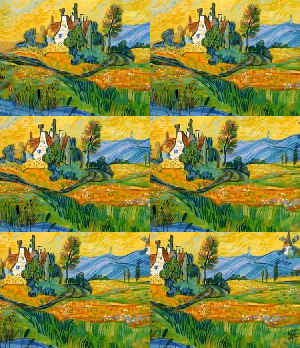
The film was theatrically released in October, 1962 to indifferent reviews and low box-office receipts. The Hollywood Reporter declared it to be ‘one of those inexplicable projects involving people of the highest talent that just doesn’t come off.’ The technical achievements of the film, however, drew universally high praise, with Variety deeming the artwork to ‘rank with the finest ever manufactured in the specialized realm of the animated cartoon.’”
Gay Purr-ee is available online here.
 Hot cocoa haven